A shape’s tessellation property is unfamiliar to most players despite their experience with video games, and it is the central component that I will need to teach my player from the ground up. Hence, I went through multiple iterations, with changes big and small, to foster a decent understanding of this mathematical concept in players. Here, I will mainly go through three major prototypes that contribute to the final MVP version.
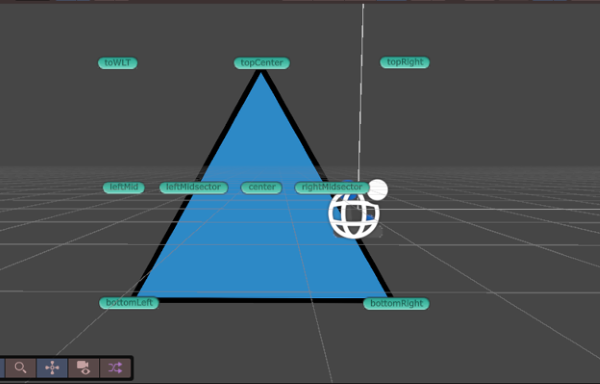
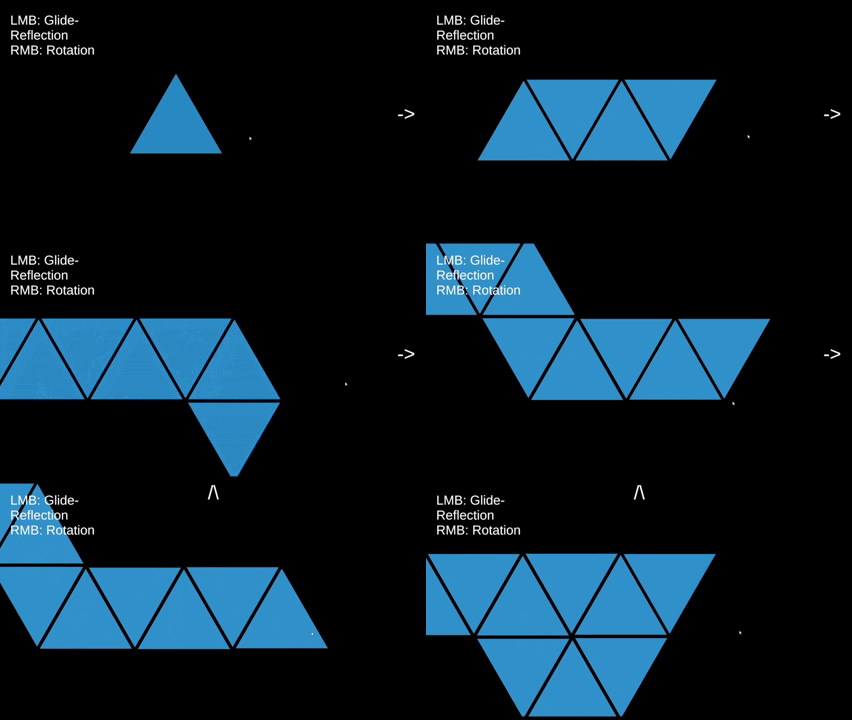
The initial prototype for this concept is 2D, and the triangle has yet to become something that exists outside of the player. In this version, the player is the triangle, and it prompts them to tessellate themselves to follow the on-screen marker in a dark environment. During its playtest, players gained a decent comprehension of the rules behind its navigation system. However, this version provided some rather troublesome technical issues on the programming side. As the picture of the triangle shown, any sprites in the Unity engine contain a bounding box that frames the actual sprite itself. Thus, the locations of its three points are not known to the engine and will need to be provided through manual calculation using trigonometry with its base and height, which is also the bounding box’s width and height when it is cropped to its edge. With this manual process its also comes with some level of inaccuracy, and during the playtest, it also presented an optimization issue as the game started lagging when more triangles were spawned into the scene.
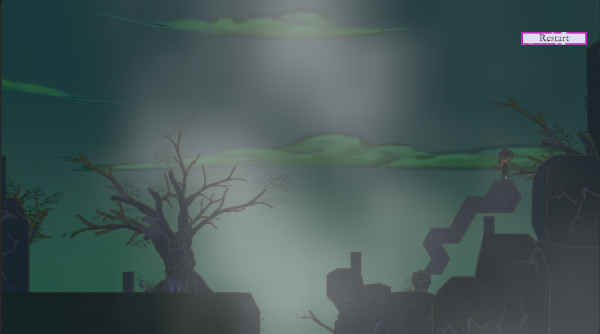
In this version, I separated the player and the triangle. The player can go wherever they want, as the space allows, but they will run into obstacles where they need to use the triangle to cross a gap or reach an elevated platform. The player will have control over switching the rotational pivot’s location and direction, which will create a tessellated path for the player. However, there are a few caveats to these controls, as the pivot’s location is not always visible, and it needs the player to toggle its visibility on and off. Furthermore, the switchable pivot options are not given but simply presented to the player. These two caveats are created to encourage consciousness in players’ decisions when navigating through the environment. However, these mechanics also created a steep learning curve for players.
The major final change is that I created an exposition of the triangle’s pivot. During a playtest feedback session, the pivot was described as having a sense of liveliness that makes it seem like an autonomous creature. I internalized this feedback and made a feature out of it. This is because, prior to this feedback, there had been frustration with the lack of control over the next pivot’s location. This lack of control is supposed to create a level of autonomy, which they would need to strategize around, thus further emphasizing the planning part of the mechanic. I see that sense of frustration as the result of a lack of explanation from the game; thus, I decided to create a reason for the pivot’s behavior: it’s a travel companion. This also creates a reason for the constant existence of an anonymous sphere in the scene, as previously the hiding and showing created an unnecessary obstacle in the player’s learning experience. I have gotten some player feedback in accepting its existence as an autonomous creature and let go of some of the original frustration.
This project is a learning process for me, both as a designer and a programmer. It prompted me to refine a completely foreign concept into a playable mechanic. It also prompted me to learn new programming concepts like procedural mesh and URP rendering pipeline during its different stages of production. For its MVP version, there is still room for improvement for players to gain a complete comprehension of the rules of tessellation. However, there is still enough understanding from most players to make it through the majority of the level.